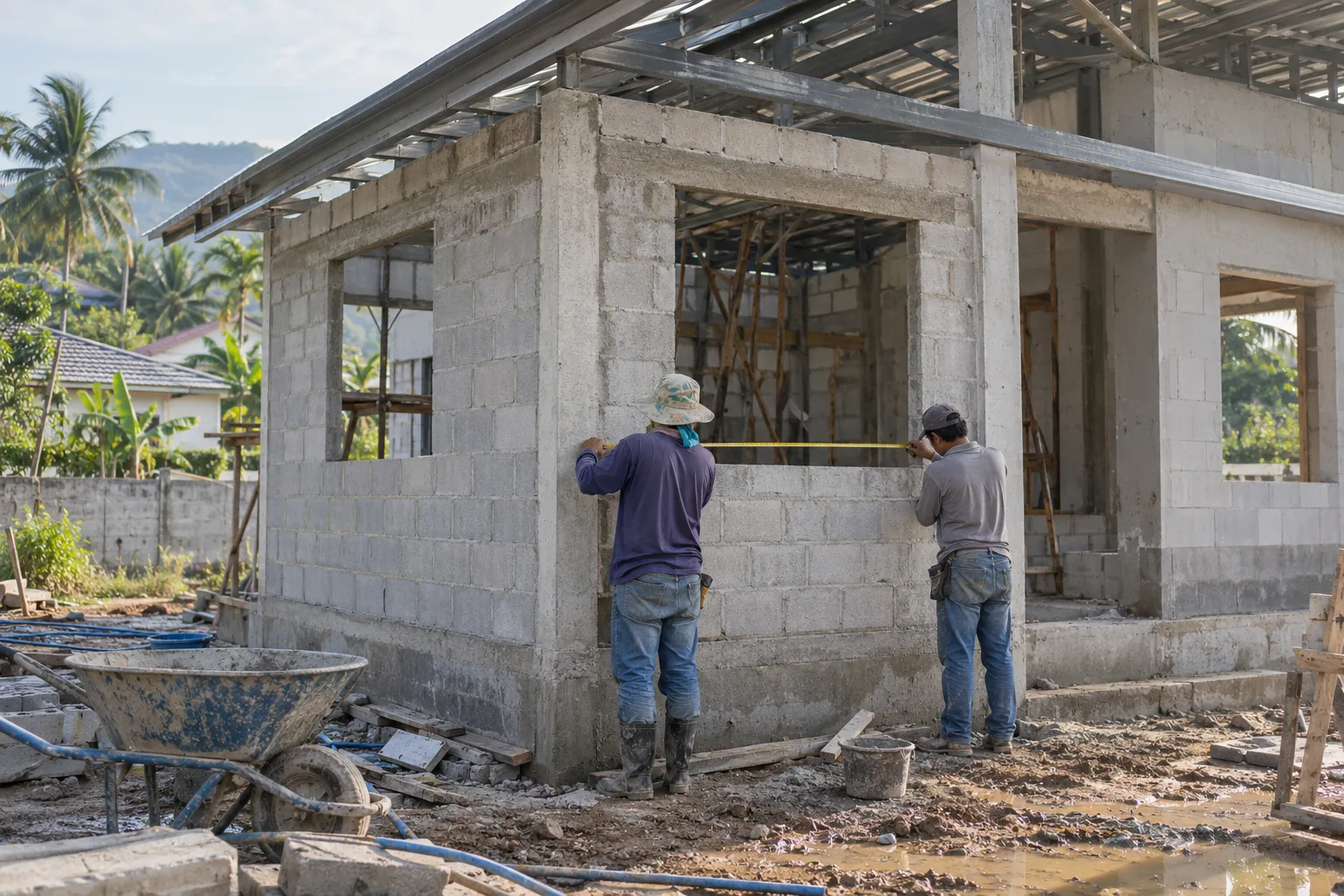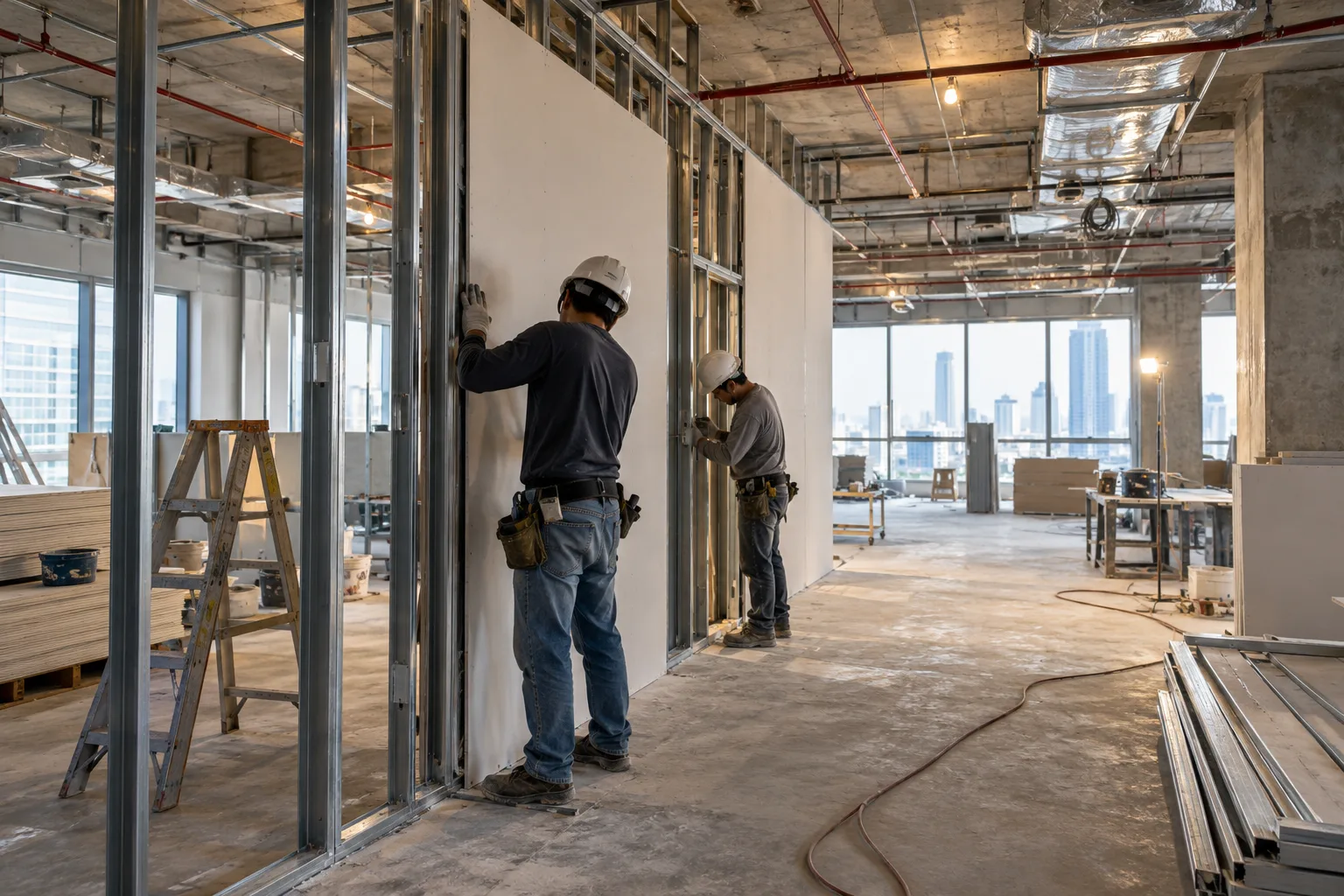
In Thai law, a construction contract is a contract for work under section 587 of the Civil and Commercial Code: the contractor agrees to complete the work and the owner agrees to pay for the finished result. The law does not require it to be in writing, but without a detailed contract it is very hard to prove what was agreed once a problem arises.
Download a free contract that fits your job
Every file comes as an editable Word file and a printable PDF. Choose the one that matches how you will hire.
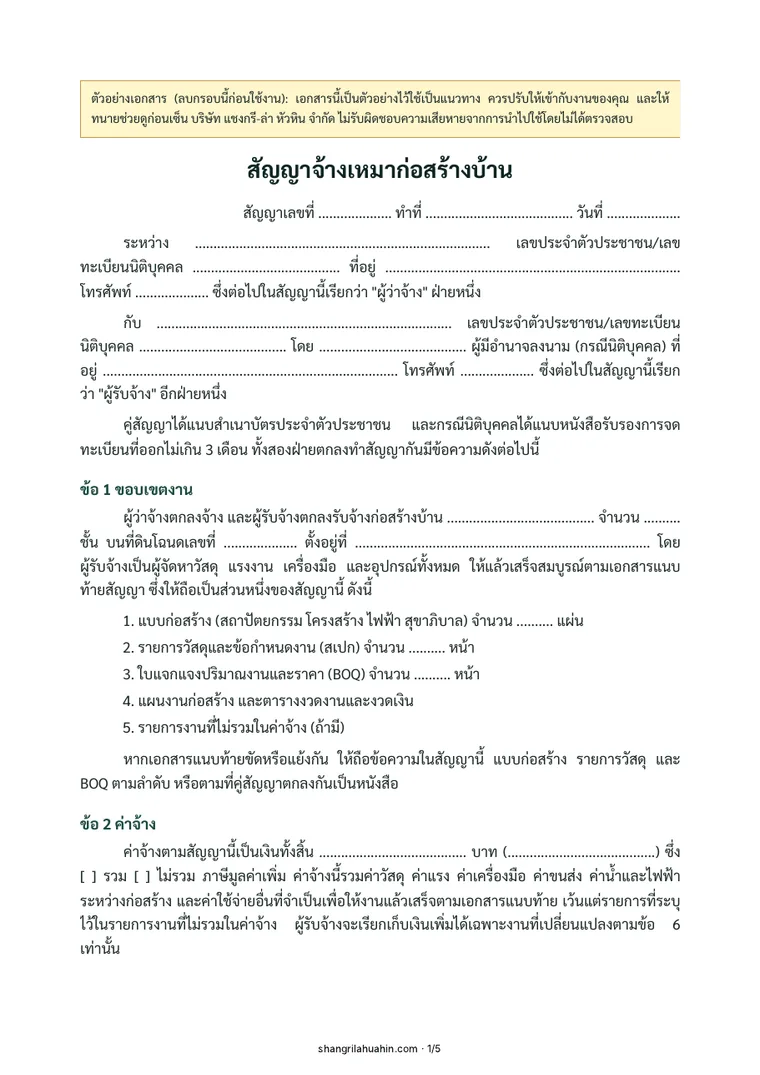
House construction contract
Hiring a contractor to build a whole new house, with the contractor supplying all materials and labour.
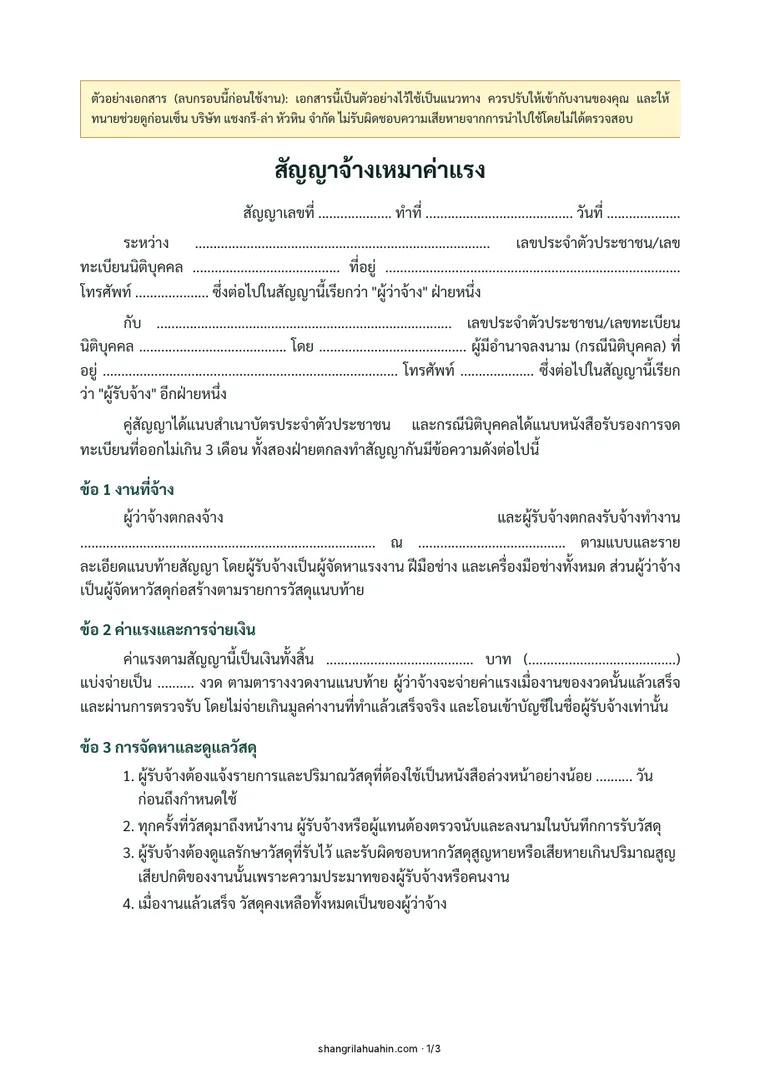
Labour-only contract
You buy the materials yourself and hire builders or a contractor for labour only.
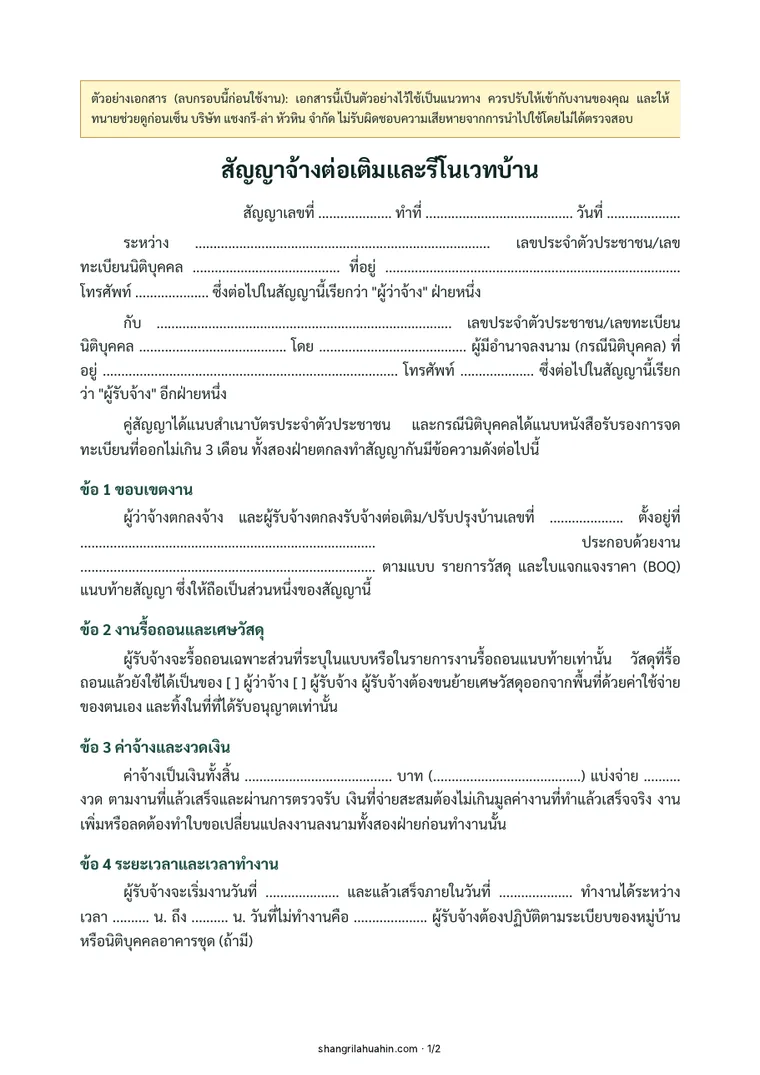
Extension / renovation contract
Extending a kitchen, bedroom or carport roof, or renovating, while you still live in the house.
Why a one-page contract is risky
The story homeowners tell most often goes like this: a large first payment, then slower progress, then requests for more money because "that was not included", then the contractor stops or cannot be reached. Looking back at the contract, they find:
- No drawings or material list attached, so nobody can settle what the price covers.
- Payments tied to dates instead of finished work, so more money went out than work was done.
- No late penalty and no retention, so the contractor loses nothing by disappearing.
- No termination terms, so it is unclear when a new contractor can be brought in.
A good contract is not only for going to court. It gives both sides the same understanding from day one, and if you ever need to enforce your rights, the evidence is ready.
15 clauses a construction contract needs
- Complete details of both parties. Names, addresses, ID numbers or company registration numbers with the authorised signatory, plus copies of the ID card or company certificate.
- Scope of work that refers to the attachments. The drawings, material list and BOQ must be stated as "part of this contract", with an order of priority if the documents conflict.
- The price and what it includes. State whether VAT, site water and power and transport are included, and list the exclusions separately.
- Payments tied to inspected work, not to dates, and total payments never above the value of work done. See how to split construction payments.
- Transfers only to an account in the contractor's name, with a receipt for every payment. Proof of payment matters when you need money back.
- Start date, handover date and work plan, with a duty to report progress with photos at least once a week.
- Materials to specification. Any change of brand or model needs written approval and must be equal or better.
- A change order for every addition or omission, with price and time, signed by both sides before work starts. This is the best protection against surprise extras.
- Inspection of work. Set the inspection period and how defects are notified, and state that accepting work does not waive claims for defects found later.
- A daily penalty for late handover, with the right to deduct it from payments. A penalty is governed by section 379 and a court may reduce it if excessive (section 383), so keep it reasonable.
- Retention. Hold back part of every payment and release it after the warranty period, so the contractor has a reason to come back and fix defects.
- Warranty after handover, separate for structure and general work, with how many days the contractor has to start repairs after notice.
- Termination terms, such as stopping work for more than a set number of days in a row, or progress so slow that the deadline clearly cannot be met, in line with the owner's rights under section 593.
- The right to hire another contractor to finish and claim the extra cost, and to take possession of the site and materials already paid for.
- Notice channels and signing. Name the email or app used for notices, sign before two witnesses and attach the full stamp duty.
Documents to attach to the contract
A contract is only as strong as its attachments. Check that they are complete before signing, and have both sides initial every page.
- All construction drawings, and a material list with brand, model and grade.
- The bill of quantities and prices (BOQ). Use the free BOQ template to compare several contractors.
- The schedule of work stages and payments, and the list of work not included in the price.
- A copy of the ID card, or a company certificate issued within the last 3 months.
During construction, use these documents with the contract
Even the best contract cannot help if nothing is recorded along the way. Use these two documents and every stage will have clear evidence.
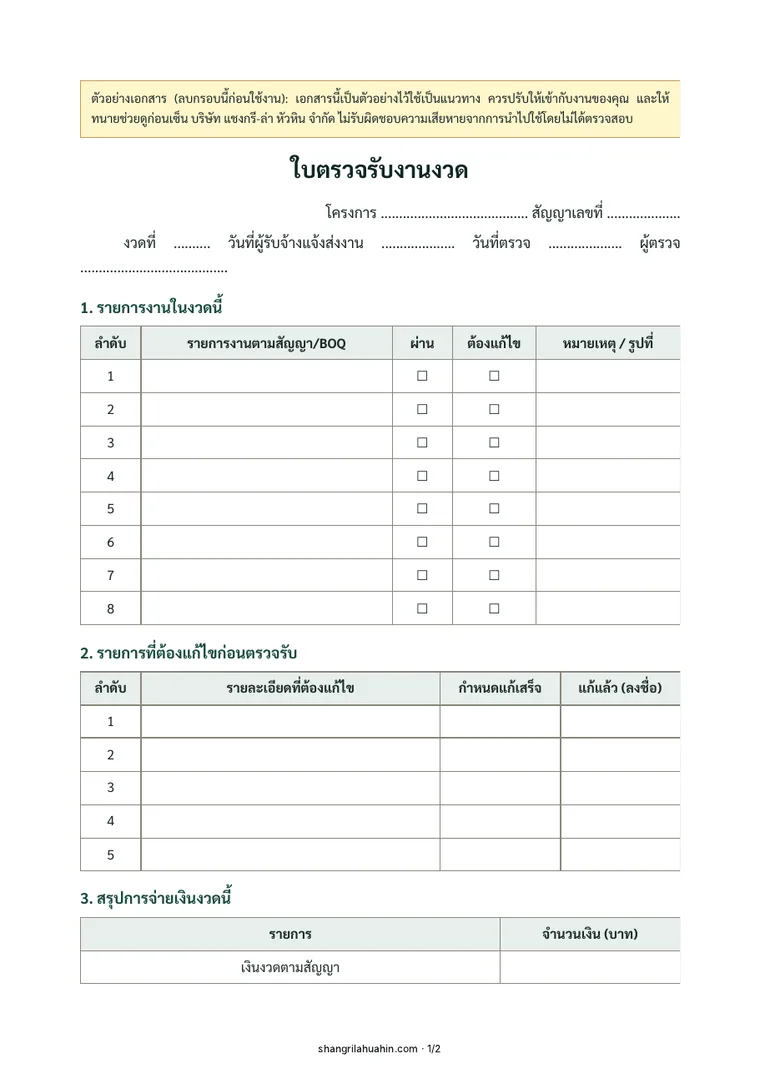
Stage inspection form
Before every payment, so you have proof the work matches the money paid.
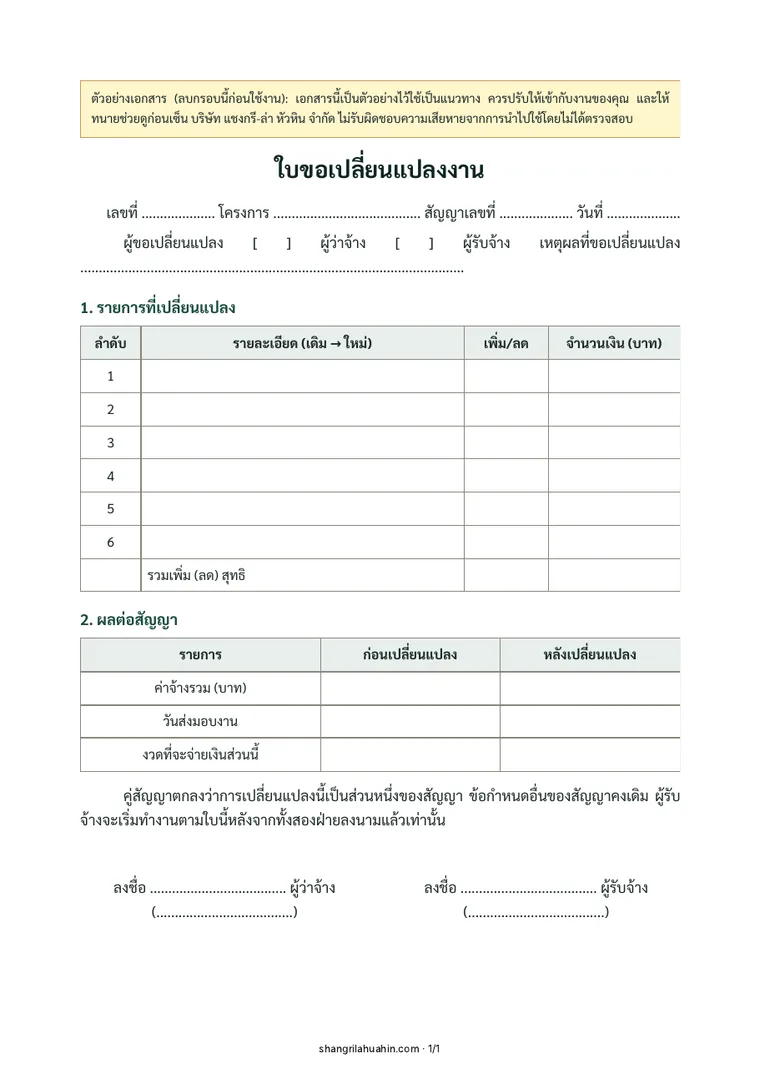
Change order form
Every time you change the design, change materials or add work to what was agreed.
If the contractor walks away, how this contract helps
When a contractor stops work, the correct steps are a written notice to return to work within a set time, then termination, then hiring a new contractor to finish and claiming back any overpayment and extra cost. A contract with payments tied to work, weekly photos and an inspection form for every stage makes the loss easy to calculate. See the full steps in what to do when a contractor abandons the job.
One more point: most abandoned jobs are a civil breach of contract. They become criminal fraud only if there is evidence the contractor meant to deceive from the start. Preparing a civil case with complete documents is the more realistic way to get money back.
Why a contractor like us gives this contract away
Because we already itemise everything for our clients before work starts: what we do, what is included and excluded, and what it costs. A contractor who means to do the work has nothing to fear from a clear contract. If someone refuses to include these clauses, think twice before hiring them.
Planning to build? See every item before you decide.
Send your location, plans or photos and we will come back with an initial scope of work.

Frequently asked questions
Does a construction contract have to be in writing?
The law does not require a contract for work to be in writing, but it should be, with the drawings, material list and BOQ attached, because it is the most important evidence in a dispute.
How much stamp duty does a construction contract need?
A contract for work needs 1 baht of stamp duty for every 1,000 baht of the price or part of it. Without full duty, the contract may not be accepted as evidence in a civil case until the duty is paid.
Can I sue a contractor who walked away if there is no contract?
Yes, using other evidence such as messages, bank transfers, site photos and witnesses. It is harder to prove the scope and value of the work than with a contract that attaches drawings and a BOQ.
Can I use this free contract as is, or should a lawyer check it?
The contract is a sample to use as a guide. Adapt it to your job and have a lawyer review it before signing, especially for high-value work.