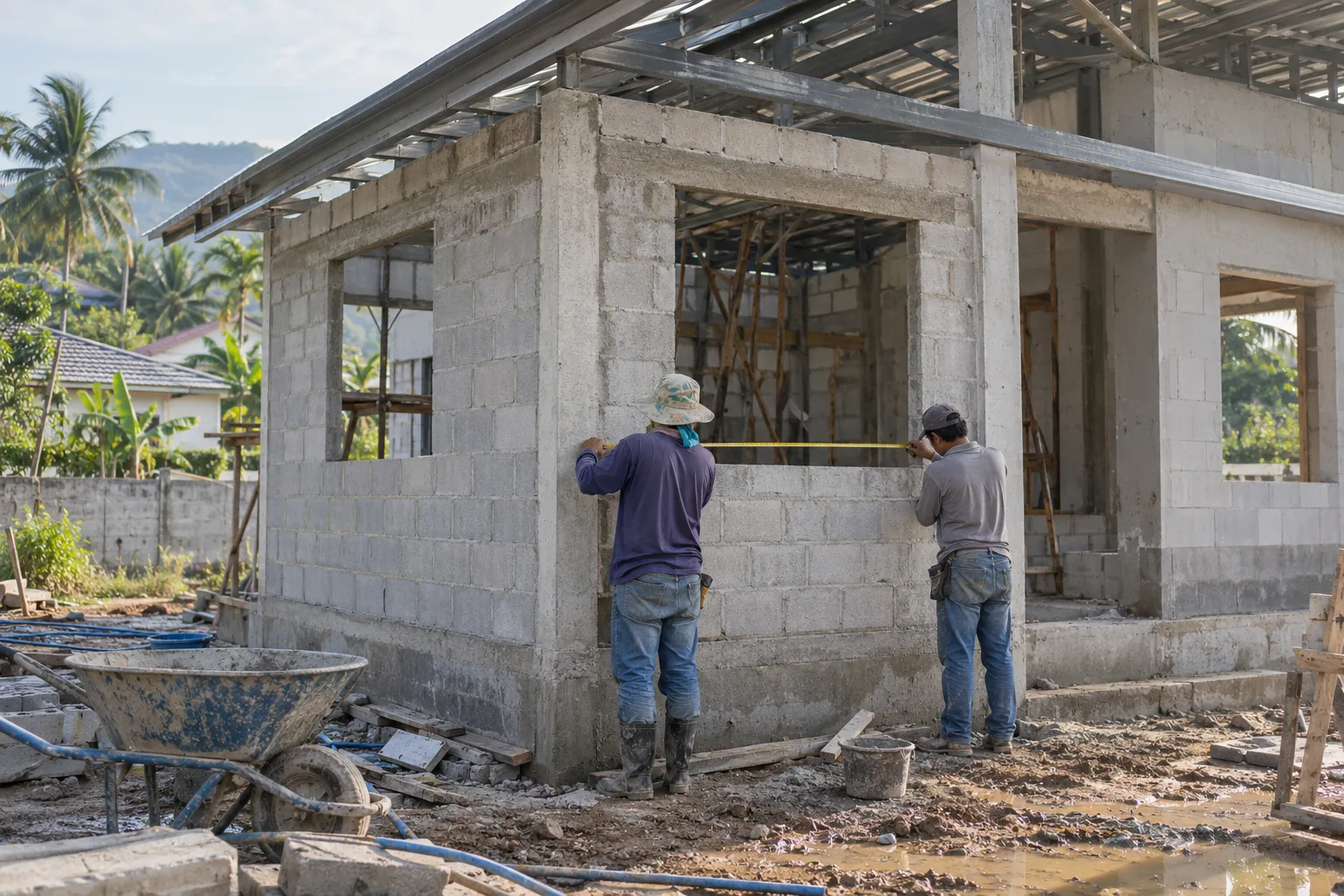
One contractor, or phases?
| Approach | Upside | Watch out for |
|---|---|---|
| One contractor for everything | One point of contact, one standard for every house | If they hit trouble, the whole project stops |
| One contractor, in phases | You see phase one before releasing the next | The terms for the next phase must be written clearly |
| Several contractors | Spreads the risk, lets you compare | Harder to keep one standard; you need your own site supervisor |
For a first project of 5–10 houses we'd suggest the middle one: a single contractor, in phases. Start with three houses. If the work is good and payments run smoothly, carry on. You are not tied to someone you've never worked with.
Check the contractor first
- Is it a registered company? You can check the registration number with the Department of Business Development for free.
- Can they issue tax invoices? Your project accounts need them.
- Visit a live site. Work in progress tells you more than photos of finished houses. Is the site tidy? Is someone supervising?
- Ask about the team. Is there a site engineer? Are the workers their own crew, or is everything subcontracted?
- Ask about cash flow. Directly. A contractor who can't buy materials until your stage payment arrives is your risk.
The full checklist is a free download below.
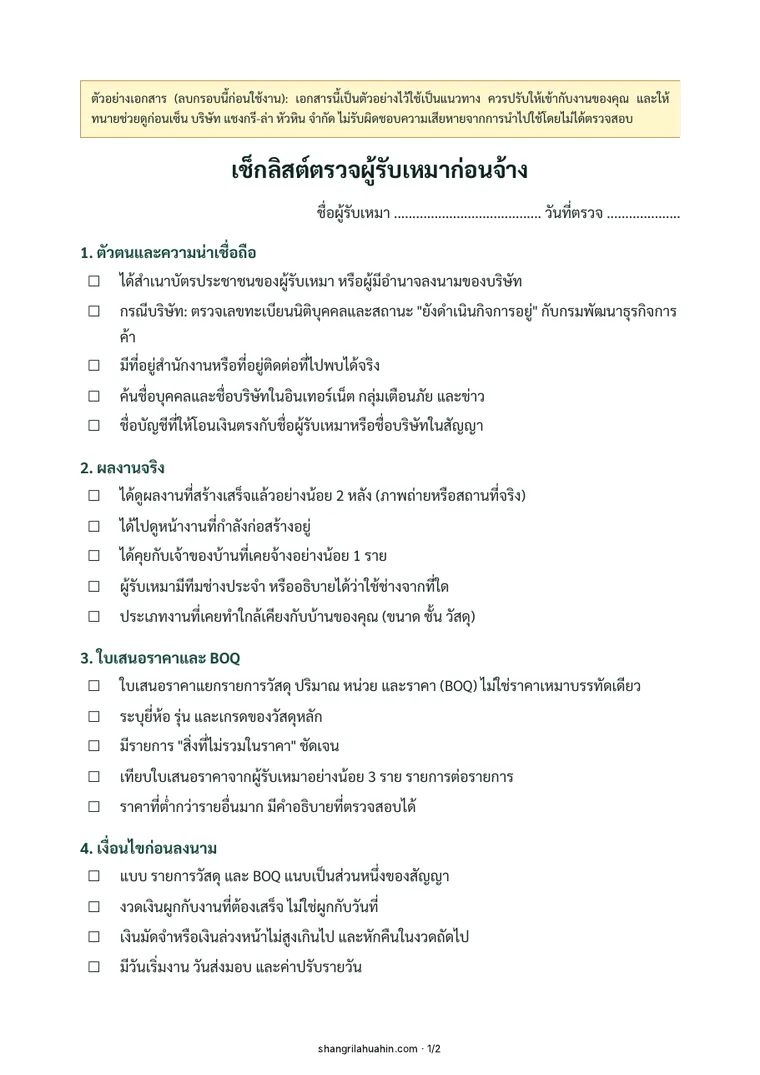
Contractor hiring checklist
When choosing a contractor, before paying the first deposit.
Compare with a per-house BOQ, not a price per square metre
Two contractors can quote the same price per sq.m. for two very different houses. Have every bidder price the same drawings, the same specification and the same BOQ, then compare line by line. You'll see at once who left what out.
For example, our BOQ for Hip Garden has 13 sections and totals 1,676,594 THB per house. If you build the same plan several times, quantities multiply directly, and bulk buying usually helps the price. How much it helps depends on real quotations, so we won't give you a made-up number.
Set payments so money and work move together
It is the same rule as for a single house, applied house by house: each house has its own stages, paid after that stage is inspected. Our BOQs use 7 stages and keep the last 5% until handover.
- Retention. Owners commonly hold back part of each payment and release it after the warranty period. Agree the share in the contract.
- Delay penalty. Set it per day, with a cap. Your buyers have transfer dates, and every late day is interest you pay.
- Changes. A signed change order before any change is built.
Make the first house the standard
The first finished house is the ruler for the whole project. Inspect it closely, photograph everything, and write into the contract that every later house must match it. It saves a lot of arguments.
The law in brief
A construction contract is a hire-of-work contract under the Civil and Commercial Code. The contractor is liable for defects for 1 year, and 5 years for structures on the ground. As the seller you also owe your buyers under the sale contract, so the warranty your contractor gives you should be at least as long as the one you give your buyers.
This article is general information, checked against public sources in November 2026. Laws change and every case is different. Before you sign or pay anything large, have a Thai lawyer review your own documents.
Planning to build? See every item before you decide.
Send your location, plans or photos and we will come back with an initial scope of work.

Frequently asked questions
How many contractors should a small project use?
A first project of 5–10 houses usually suits one contractor working in phases, so you can judge phase one before releasing the next.
How do I compare contractor bids?
Have every bidder price the same drawings and BOQ, then compare line by line. A price per square metre alone says nothing about material grade.
What is retention?
A share of each payment the owner holds back and releases after the warranty period, so the contractor returns to fix defects.